Episode Transcript
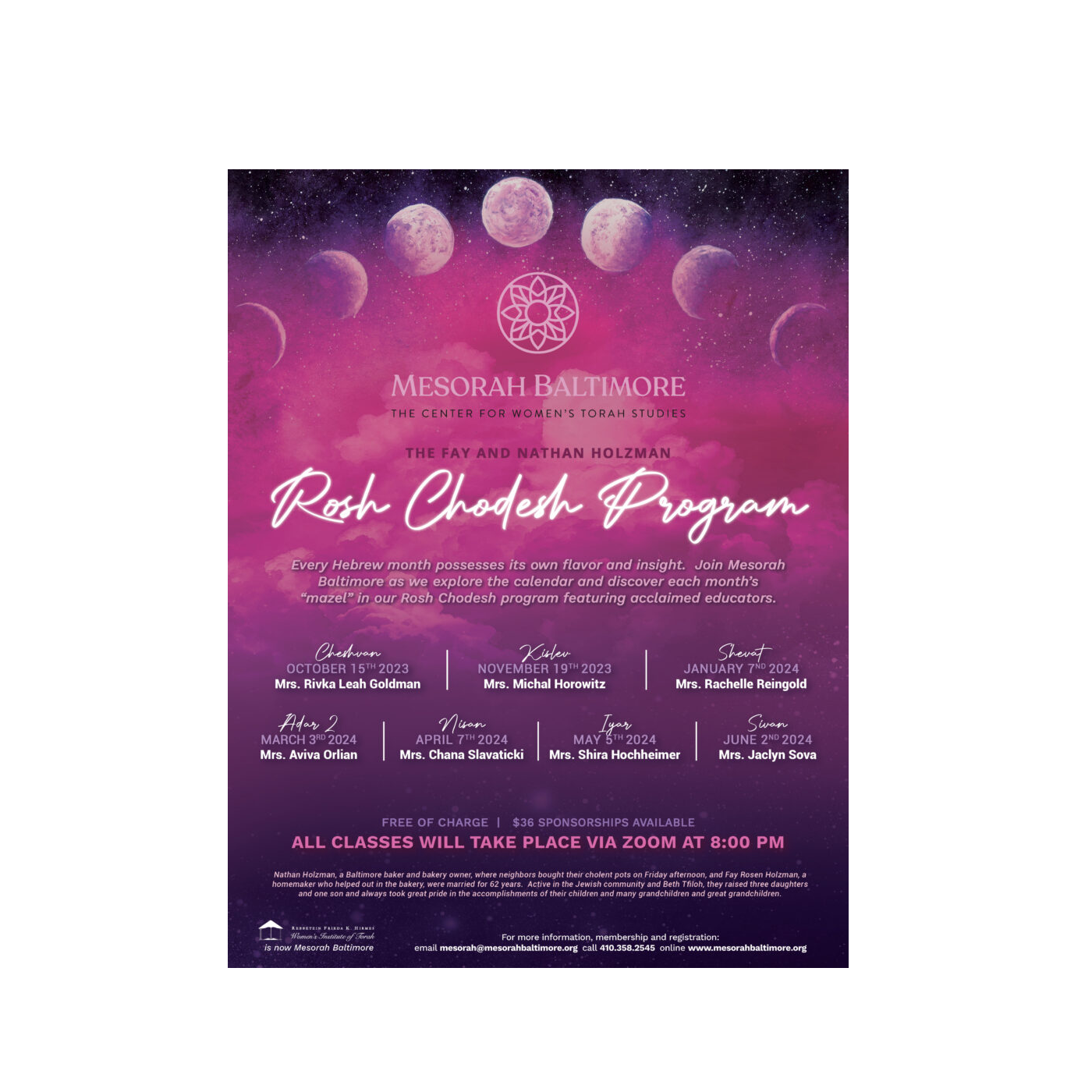
[00:00:01] Speaker A: Okay. The Silver Baltimore Roch Potash program is sponsored in memory of Faye and Nathan Holtzman. And may all the learning that is done during the entire series be an Alia Sedona Shamos. Tonight's program has been sponsored by Julie Meister in memory of her parents, Avram Moshe Ben Sviyoal and Leah Bas Mordechai in honor of Sharon Zuckerbrod for being honored at the recent federation, the recent Federation of Jewish Women's Organizations of Marilyn's lunch by a group of her friends, Shoshana Narani in memory of Hanum Bas Rahamim, Cindy Ring, Lilo Nishmas, Chaim Yaakov Ben Michal, Simcha Limi Michel as is a phosphorus for Shalema for Usher Ben Yehudis Linda Elman in memory of her father in law, Yehuda Ben Michiel Michel, whose yard site was this past Shabbos and Idy Goldsmith Ilo Nishmas, her father, Herman Roth Yesto Bako Palavi, whose yard site is the third of Sivan and her mother Rosa Raw Mariam Basako, whose yard site is on the 14th of Sevon. And we thank everybody for their sponsorships and enabling us to continue this program. Just a reminder that if you can leave your cameras on, we always appreciate teaching to faces. If not and we see things like your ceiling tiles or your floor or your laundry basket, we may go ahead and turn that off for you. Please do not be insulted. We just don't want you disturbing anyone learning here with you.
It is a real treat for us to have Shifra Ravenstein join us this evening. And I will be completely transparent. Shifra is pinch hitting Aviva Oran was on our original schedule Bar Hashem, her daughter was getting married. We planned these things about 10 months in advance. And at the time Shifra couldn't find a date that works for her and Aviva could. But now this is what. What Hashem wanted to happen.
So as you know, we are covering a the day of Creation that corresponds to our day of Rosh Chodesh. So we are very excited to hear what to. To hear what Shifra has to say, because we know it's always amazing and just a plug. She will be opening up our summer series on Monday, July 6th at 10am so keep that in mind. So with that, I'm going to go ahead and spotlight Shifra and we're going to get started.
Good evening, everyone.
[00:02:27] Speaker B: Good to be back here in Sora Baltimore.
Our subject for this evening is Yom Rison, which is confined to the first five Sukim in all of Torah.
And my hope is that as we explore explore these sukim together, we will find messages that are not only relevant to our lives, but particularly relevant as we enter into the month of Sivan. Over the course of this year, we'll be transitioning from Aleph Sivan to be Sivan from the 1st of Sivan to the 2nd of the month, getting inching closer and closer to the day of Kabbalah Satorah.
If you just take a glance with me at source number one, because these are the that we will be referring to throughout our time together this evening.
Again, just the first five sukumin chumish. They should be familiar to most of us.
In the beginning, Hashem created heaven and earth, and the land was basically nothingness and emptiness.
I'm not going to go too deep into these because they every one of these can be an entire shear unto itself.
And Hashem said there should be light, and there was light.
And Hashem saw the light that it was good.
Hashem separated between light and dark, and Hashem called the light day, and Hashem called darkness night. Vayhi erev vay hi voker yom echat. And it was evening and it was morning, and it was one day or day one.
And that small section is our subject for this evening. But there is so much packed into those five Sukim that we're actually only going to be able to address a small portion of it.
But I'm going to start with the very first pasok, and not just the very first posse, but the very first word in all of Hamish, which again can be probably a three part series unto itself.
And we are going to start right here. This is the beginning.
And if this is the beginning, that it is appropriate for us to ask why was the world created altogether?
And that is really what Rashi is addressing in source number two, in a very famous statement that gets quoted a lot this time of year.
Basically the text is begging to be examined and explained. Kemosha, drashuhu, rabo senu, just like our sages explains and elaborated on these words. And they took apart the word racist, which we translated simply as in the beginning. And they said really you can separate the base, in which case it would be bit racious, which they translate to be four racist. And then the question becomes, so who or what is racist?
The world was created for Torah, which is called racist, as in racist Darko, as in the Pasak and mishli. And then Rashi brings a second explanation, the medrash by the way brings many more than these two. But these are the two that Rashi chose to bring.
He brings a posse from Yirmia in which cloud Yisrael are referred to as racist. And so Arashi says, is that in that first word is the mission statement for all of creation.
The world was created for what?
For Torah and for Claud Yisrael. That's why we have a world.
The Sefer Merosh Tsurim, written by Rav Moshe Rice in source number three, elaborates on this Rashi as follows.
Even before Rashi approaches and begins to explain the simple text, in understanding the creation of heaven and earth and all that came along with it, Rashi sees it appropriate to take a step back and say one second, before we talk about what is created, let's talk about why it's created, What reason, what goal stood before. The Master of the world stood before when he sought to create a world.
And then he continues, The answer that Hazal give us in response to that question is.
That the purpose for all of creation is Torah and with it Clal Israel, it's nation, cloud Israel, Shomre, Mishmera, Sakodesh. We are the ones who keep and guard its its uniqueness. Lazaro Mezata.
And that is what the Torah is alluding to as it opens its words to us. Be racious Hainu bishvil horus before because of and for the sake of the racist. The thing which is first, the thing which is primary. And we have two things, so to speak, which take the title or the role as of primary. One is Torah and one is Yisrael. And really they work together.
The reason Hashem created the entire heaven and earth was for Torah and for us.
That is why everything that you see exists for Torah and for us.
That's the goal.
That's the reason.
That's the purpose for Torah and for the Jewish people who are the ones who will keep that Torah. And we must and are instructed to live with that consciousness.
There's a reason that the Torah opens with that word which is not just informative, but in a way is an instruction. This is the reason the world was created. Live with that awareness of why Hashem created the world.
As Reversh says in source number four, for all these ends, even if only developed later, must have been ensured right at the beginning of the world. Meaning to say, there might not yet be a cloud Yisrael and Torah was not yet given to mankind for the throughout the entire safer Beratius and not until the middle of safer Schmos and yet we reference it, even if only by a hint right at the beginning.
Just because the world was created, voracious came into existence completely out of God's hands, so that from its very inception it was formed for these higher purposes. God, as it says right. The Hebrew phrase is the. The Mimer Chazal states that Hashem looked into the Torah and created the world accordingly, so that in this we see the cornerstone of our awareness of God and the world.
And when this awareness had disappeared and was to be established afresh, we can understand the free will. The unlimited sway of God over the world had to be proved by miracles. Let's pause and understand what that means. I always say, I think the English of reverse is harder than a lot of the Hebrew of the other referson that we learned.
So what are we saying? We're saying that a Kuroshboro who wants to make sure that we have the ability to live with that clarity. And if you think all the way back, who gave us there's this is. There is, I believe, a hint here to the experiences of the miracles of Mitsrayim that Akadosh Baruch Hu felt it important to make sure that he proved to us and he showed the world, that there is a Creator and there is a Master of the Universe running this world.
Let's continue these as Nissim, which another word. We usually generally translate the word nis as miracle, but it also is translated as banner.
Banners held aloft as directing and guiding signs were to lead us back to regaining the consciousness of the free, completely unhindered Almighty of God.
Consciousness, which we have indicated forms the preliminary condition for all man's consciousness of morality.
For our whole relation to the Torah, we must live with the awareness that there is a Creator and that he continues to run the world.
And that has to be part of our awareness, because that was the reason for which the entire world was created.
There should be a people who live with the knowledge that there is a Rabuna Sholom Hashem is here.
The world was created with a goal, with a mission, and we are here to represent that.
That is why, says Rav Moshe Feinstein in the Drash Moshe, that is why the Torah begins with voracious.
It's true that the word beratius tells us that there is a goal.
But in order for us to be able to live towards a goal, we have to start with that there is a Rabuna Shaolam who created the world, says Ramosha Feinstein in the Drash Moshe in Source Number five.
It also seems that this is an introduction really to all of Torah mitzvoshu. Ma', am, you cannot be considered a person who keeps mitzvahs unless you trust and know that there is Hashem who created everything. Otherwise, why are you keeping mitzvahs?
Because if there isn't that amuna, if you don't know that there is a God, that there is a God who created the world and runs the world, then what relationship do you have to keep in mitzvos? You're just going through motions that come from where?
And therefore it specifies for us that in the beginning Hashem created perish voracious. The explanation of voracious is cold.
All of the words of Torah are the they force us to know, period. Plain and simple, Hashem created the world. This did not self create.
You and I are not here because we just came to be. There is a Rabonisholem who actively created the world.
And this also explains the question that Rabbi Yitzchak is quote. Rashi quotes Rabbi Yitzchak as saying in the first Rashi and Chumash.
Therefore we needed to open with.
Let's just explain those last couple of lines for a minute.
The first Rashi and Chumash.
Rashi asks the famous question, why did Torah start with Gracious Bara Elokim?
Why didn't we start with the first Mitzvah? The first mitzvah is why didn't we start Torah with the first mitzvah?
So Rashi answers in a rather famous statement, so that we should be prepared that when the world comes and says, listimatem, you stole Eretz Yisrael, we should be able to respond and say, ah, voracious parallel Kim Hashem created Shaman Varas and Hashem decided that we should have Eretz Israel. He who created the world gets to decide who has what.
Now that's a whole separate topic which I believe we once talked about in a shear about Eretz Yisrael, why or how that would be effective. You could just imagine going into Gaza and saying, listen, Hashem created the world. He gave it to us. Like, put your arms down, people. You know what I'm saying? But that's not our topic tonight. But says Ramosha Feinstein, but there's a very simple explanation. Aside from that, that might also be true. But aside from that, there's a simple explanation. Why did the Hashem start the Torah with voracious Bara Elohim and not with the first Mitzvah? Very simple.
Because there's no point in keeping mitzvahs. If you don't know that Hashem created the world, if you don't know that there is a master of the universe who created the world and is running the world, and what do you whose mitzvahs are you keeping anyway?
And so it's, it's, it's essential. It is the pillar upon which everything is built that is the foundational knowledge.
Hashem created it. And Hashem created it with a purpose and with a goal and with a mission in mind. And we are the people who are intended to live with that acute awareness that Hashem created the world and created it with a purpose. And we are supposed to live towards that purpose.
And we are here to be the people who show what it means to live every part of your life with awareness of Hashem.
And let's be clear, it's not just that a Kadishpur who created the world, but that everything that exists is because Hashem wills it to exist.
If you take a look at Rafayam Friedlander and the Sifze Chaim in source number six, this is taken from a two volume set of Rav Chaim Friedlands or of the sifting which is printed on Emunah and different topics related to Amuna and says the Sifzechaim. We're going to start about five words in on the first line where it says.
In our statement that Hashem created the world.
Obviously we don't mean that Hashem said, could you pass the hammer?
Could you pass a couple seeds? Like I need to plant something.
Obviously Hashem didn't need tools to create the world. Hashem created the world. As we say Yesh me ayin something from nothing he created and it came into existence. But more than that, it's different.
It's different than a person who wants to create some kind of object that he needs to use some kind of vessel, some kind of kleem malacha, some type of work tool in order to be able to make that object that he's trying to make.
Hashem creates with one thing.
And he only needs one thing.
And that is Debor.
All Hashem needs to do to bring it into existence is to say it.
And it is.
When Hashem wanted it to be something that was created, it became a creation.
Because the will of Hashem is something in existence and Hashem creates that which exists.
So again, Hashem doesn't need a tool to make it happen.
Some doesn't need anything to make it happen. We actually learned this from our Sukim that We started with day number one. This is day number one of creation, Yom Rishon. Our topic for tonight is where we learn this message. Because the first time that a kadishbara who was going to create something is here.
Yeah, there are. We say there are 10 mamaros, 10 statements that hashem used to create the world is one of them.
But if you go back, scroll back up to source number one. When we looked at the opening Sukim and posse Dalid says sorry, Pasakiml says Vayomer Elokim and Hashem said let there be light via he or and there was light.
That's how it goes says and it becomes something in existence.
Let's go back to the piece from the sips that we're in the middle of in source number six. And we're starting with the word lefiza, which is five lines down. Thank you for putting the cursor there.
According to this, we need to understand Madua amar hakaso Vayoma Elokim Yahior. This is why the posse says Hashem said let there be light. The posse does not say.
It doesn't say Hashem wanted there to be light and there was light. The posse says Hashem said there should be light and there was light.
Because the word saying in conjunction when attached to Hashem, it means Hashem wanted.
When a human being wants something.
And he wants other people that we should know what he wants, he reveals to us his desire.
He tells us, right, I want something. I have a dream. I really want to plant a tree in my backyard. And I tell you I want to plant a tree in my backyard.
When we talk about.
So yes, the understanding of saying is revealing of will the kashir on ro imes maase Hashem be poel. And when we see an act of Hashem in action, which is the outgrowth of his will.
So as opposed to man, let's just clarify as opposed to man, where if I want to do something, it happens in steps. I want to plant a tree. I tell you, I want to plant a tree. I get the tools to plant a tree. And then I try to make that reality by planting a tree, which I've never done successfully and good chance I never will. But that's not the point.
But when it comes to Akashbaraku says, and it is, that's by the way, a bracha that we make all the time.
That everything came into being, comes into being with his word, Hashem says it and it is and it becomes reality doesn't need any in between pieces to make that happen, says Refresh.
Let's take that one step further. In source number seven.
Not only the coming into existence of things, but also their continuance in existence is directly dependent on the free will of Hashem and on his satisfaction.
Once the art of a human inventor has created something, in most cases its continued existence gets beyond his control. He has created it, but it goes on existing by itself.
Yeah. I heard somebody say recently that. That the people who created AI don't really know what to do with AI and don't even really understand how it works anymore.
Yeah. There's such a thing that a human being can create something and then it runs away from you.
Yeah. How often does the work grow over the mortal head of the one whose hand made it?
Almost prophetic that one can create something and then it spirals way beyond what the person had even intended when they created it.
But when it comes to the Rabun Sholam, it's not just that Akadosh Baruch who created it. Yes, Hashem created Yeshmay, and Hashem created something from. From nothing. Yes, Hashem created the world, but it's not just that Hashem created the world. Hashem continues to have complete dominion over that which he created. And if you look at the end three lines up from the bottom towards the end of the line, the detail and the whole have not only come into existence through his almighty will, but it continues in existence only because his insight finds its continuance good.
Which, by the way, means that anything that exists in our world by definition means that Akarishbara wants it to be here.
Because everything that exists is because a Kadish Baruch who wills it into existence and continues to will it into existence. There is nothing that exists outside of rats and Hashem outside of Hashem's will.
So let's recap what we said so far before we take our next step.
So far we said that Akush Baruch Hu created the world for racists. Who is racist? Racist is Claud Yisrael. Racist is Torah. And really, that's probably the merger of the two. What is Claudia Israel keeping Torah?
What does that mean? It means that the world was created with a vision and with a mission. And we are the people who are supposed to live that with that awareness of Hashem, we are the people who are supposed to live with the knowledge that Hashem is the Creator, Hashem is the Master of the universe, and we are intended to live in accordance with his will.
And that knowledge is a prerequisite to Keeping Torah to living a life of Torah. I have to know there is a Ravonosom who created the world and continues to run the world. And I have a mission in being here.
And we are charged to live with that mission.
And now let's move our discussion into a discussion of what was created on day one.
So we already read together the Pasuk.
Hashem said let there be light. And there was light.
So the Nasir Shalom asks why it mentions.
Excuse me, why it mentions what there was prior to that light, Meaning that it says that the land was the arts. I thought so.
Nothingness and emptiness.
And he also asks how Vayomer Alokim y or was really an antidote to that nothingness, to that emptiness, to that darkness.
So he answered that the Bria was divided into two parts. And we're now in source number eight in the first line.
The SR.
That the. The.
The. The topics. The subject of the Bria is divided into two parts.
We have those things which are, let's call them, heavenly. They are shamaimi, okay, from the word shamayim. They are the parts that are attached and have connection and relationship to the neshama.
And we have earthly things, things that are artsyim, earthly, that are connected and work and more connected and attached to the gulf, to the body.
And when the Torah tells us that the land was sohu, vavohu, nothingness and emptiness, these earthly things, that man is really like, sucked in by them.
It brings a man to a state of confusion, of nothingness, And it forces a person to feel lost, and he loses his sense of settled and clear thinking.
That is what the Yetzahara does. That is the task. That is the tactic of the Yetzahara to cause the power of a Jew to be lost.
He tries to confuse us. He tries to suck us into the materialism of this world.
And that is also the first goal.
That is his goal. Rishi's call, first and foremost to confuse a person can make you so busy and so distracted and so consumed by earthly matters that you don't think straight, That you are confused and distracted by all of the earthly matters.
That brings a person to intense darkness.
And the worst thing is really for a person to be in that state of confusion, to not know what's what.
Second paragraph here.
And the understanding of what it means when it says that the land was nothingness and emptiness, a place of just utter confusion and have carus, An existence that is just sucked in again to a world of earthliness and a world of materialism for Its own sake brings a person to be confused. Confused why he's here, confused what he's living for.
Empty.
And says we are not just talking about things that are usher.
You know, we often think, well I don't know, it's not usur.
So says.
We can be talking about things that are muttering that don't necessarily bring a person up or down.
All earthly things, even things that are sometimes permissible. It's technically mutter. But over indulgence in general in earthliness, in material things, in pursuing it brings a person to a state of confusion.
And this is here we go back to our topic right now.
And the unique singular advice that the Torah gives us is what it says next Vayomer Elokim Yehi or Vay or you know what the answer is?
The answer, the antidote to not becoming totally consumed is a life of emptiness and earthliness. The answer is let there be light.
That the light of Hashem should shine in a Jew.
That's going to save him, you know what's going to protect him from a life of being consumed and sucked into this world. When we forget why we're here and where we're going and what life's about.
Live with the light of Hashem.
Because says the Orachaim in source number nine, Don't think that just because a person has on a shama or is involved in a little bit of Torah.
That you are going to be quieted from everything that the heart is trying to do. I have so I'm protected.
It doesn't work that way. Fun of a halachlo that you could just kind of like do your own thing. It's going to leave you alone.
If that were true, there would be no.
There would be no system of reward and punishment. Why would there be?
Because you wouldn't have any struggle.
If just by virtue of the fact that you had an ashama you didn't have to do anything, then you wouldn't be fighting for anything. Then what are you earning any reward for? Then there's no. Then there's no choice.
Darkness is still in the world.
But Nan has to wage war against the darkness to separate it from upon
[00:35:46] Speaker A: him
[00:35:49] Speaker B: so he shouldn't fall prey to it.
Our job is to fight the fight.
It's light against darkness is to bring more of Hashem's light into the world is to stay connected to what is real.
The light is what Hashem gave us to be able to see what is real and what is right in front of us. It represents the light of Akada Spur who in our lives.
I just want to clarify before we move on in this discussion, something that is referenced in a whole number of places. I happen to have brought Rap Pinkus and source number 10 because I thought he explained it very clearly and succinctly that yeshne suge or there's two types of light. And I think I'm just parenthetically clarifying this because this is our subject and I don't want to leave off with confusion.
On the first day of Bria Saolam, it said, let there be light.
Hashem created the light.
If you remember the Rashi from Beretius, Rashi tells us that Hashem created the light. And then the posse says separated the light. And Rashi tells us, quoting Chazal, that after Hashem created the light, Hashem decided to hide that light away for the Sadiqim Lassid Lavo. That's what Chazal tell us.
The light that we have in the world today.
Middle of the second line.
The light that we have today is really the light that was created on day number four by hanging the luminaries in the sky, the sun, the moon, etc.
Okay, so Hazel explained that we can't really have the light that we had in the beginning. Okay, because I'll explain all different reasons for that. We're going to talk about that in a second. So the light that we have in our world today is not the light that was the Yahi or light, but. Second paragraph. But Ola may know, in our world, We don't have the ability to physically see with our eyes. The existence of the light that we're talking about with our natural senses. Shalanu, Light is only an intermediary way.
I think that's supposed to be an Aleph. I apologize.
To see the things that are in existence around us, we don't actually see. The light itself.
Taught us that that light was put away.
Now let's just talk this out a little bit.
The Mafarsham explained that a Kadashpark who had to hide away that light because otherwise we would have had such clarity that we basically wouldn't have had Bakira.
But says the created the world with that light anyway, even though he knew he was going to eventually put it away. And Rev Dessler compares it. It's not on our sheets. But if Destler compares it to a a child in utero being taught all of Torah, we know that Khazal say that a Malach comes and teaches a child in utero all of Torah. Why? What's the point? Of that he's going to forget it anyway upon birth.
And he explains that the reason is because once you had it, it's easier to reattain it.
And he applies that same concept here. Why the kadish baraku create that light if a kadish baruch hu is anyway going to hide that light.
So explains Rev Dessler, because it's easier to retain if you once had it, it's easier to gain back something that you once had. So therefore, as the Messiba shalom taught us, we want to see more of Hashem's light.
Because that light is really the light that helps us to battle the darkness.
That light is the connection to Hashem that helps us to battle the pull of earthliness that leaves us confused and empty.
The type of light that we're looking for is the light that helps us to see what's true and real.
So I'm going to share with you now a a piece from Ravincus. This is something that Rapinkus talks about in a number of places. And I know I shared this actually from a different source. This is from the Tafarashim shown. But I shared this once from the seahorse of Rapinkus.
He talks about this in relation to Hanukkah, but I'm quoting it here from the Tefera shim shown from Beretius and source number 11.
Hadavar kayam OLO says Rapinkus, when it comes to light, let's just establish something.
The difference between light and dark in. In regular practical terms has nothing to do with whether something exists in front of you. If you're sitting in a completely dark space, the table in front of you is still in front of you. The only difference is that I no longer able to see it.
Everything that exists in light also exists in darkness.
The difference is in me. The difference is not in the existence of what's in front of me. The difference is in my ability to see it or not see it.
And then he goes on to say that.
That this world is compared to darkness and olam habas compared to light.
That everything that exists in the world to come is really found here. Froslafaninu. It's spread out in front of us.
The essential difference between olam hazeh and olam habahu jabba olam haba adam roa es haemas. It is light.
In olam Haba we're able to see truth, the kanba olam haze. And here in this world, Darkness covers truth.
And even though the existence of Hashem is really revealed.
We are stuck in darkness.
We cannot sense with the same degree of clarity the existence of Hashem and that we are living under his Ashka, under his Ashkacha.
And therefore we think all kinds of things. We think that things just sort of happen on their own, even though we know that nothing really happens on its own. We look in the world and things. Things think that things just happen. It looks like a president is making decisions.
It looks like the brilliance of national intelligence is why we figured things out. It looks like it's the military that protects us. It looks like I'm the one who earns or I own more than the next person because I'm smarter or better. It looks like my body works properly, because that's just what it does.
It looks like trees blossom and flower in the springtime, because it's spring. And that's just what happens.
But as we said earlier, Hakadah Baruch Hu did not just create the world. Hakadash Baruch Hu has, is continuing to run the world. He didn't just make an invention and allow it to run away from him. He maintains complete dominion over the world that exists.
There is a rebuild. Who's running the world? Lev Melech Bia. Hashem, the president and the heads of countries make the decisions that they make because Hashem controls it. And Hashem alone is the BAAL Hamilchomos. He is the one who directs all worlds, all wars. And Hashem is the Mefernis la Col, like we say in Bensheim. He decides how much Parnassa and who was gifted with which strengths.
And Hashem is the one.
Hashem is the one who created man with wisdom and makes a body run and work.
And Hashem is the one who brings leaves and flowers to bear branches.
We have to turn on enough light to see that a Kuroshbur who is right in front of us.
And the light that we are talking about is the light that allows us to see that nothing happens on its own.
The same Rabbano shalom who created the world, the same Rabbon Hasholem who said and there was light, is the same Rabbano shalom that makes us be able to see every day.
He wills the world, the world, into existence.
So how do we do that?
How to create more of that light for ourselves? How do we attach us to more, attach ourselves to more of that light? And the answer is by attaching ourselves and to his toe.
That's what allows us to see that it's not to see. Not just an external object, but to see Hashem behind it. To see not just the news, but to see Hashem behind everything that's happening, says Rapinkus. A person who lives without Hashem, who doesn't know what the world is really here for, and doesn't know what he's seeing, and doesn't know that Hashem is running the world, and he doesn't see that there's Hashem. And maybe he doesn't even know of Mitzvah. Such a person doesn't see. He's living in dark.
Our job is to live with the light of Torah and the light of connection to Hashem, and to bring the light of Akada Sparrow into our lives so that we don't just live in earthly existence of Tohu, bavohu of nothingness and emptiness.
The answer is Yahi, or bring more of an attachment of the light of Akonosparaku in.
And I'll end with this one last piece.
If we go back to the. The. The Pasok that talks about.
Excuse me. We go back to the posse that talks about how a Kadishbara who saw.
Hashem saw the light, that it was good.
And the Mafarsion points out that that's interesting because by the other days of creation it says simply at the end of each day and Hashem saw that it was good.
In this case it says Hashem saw the light, that it was good. Which leads Chazal to say that or is good, that light is good. And there are a lot of places where we see them. In Tanakh. I'm not going to go there now, but says R.A. pinkus. And I think this is a fascinating piece and also instructive.
We call our holidays Yamim Tovin. I don't know if anyone's ever thought about why we call them that, but it's interesting. And yes, they are good days, Yamim Tovim, they are good days. Rafinka says it's deeper than that.
Source number 12.
The understanding of the name Yamtif Yom Tov that we use by all of our holidays. We even refer to it by Tishabov.
Its root is in the Pasok that we referenced that Hashem saw the light, that it was good, That since Hashem saw the light that it was good, Hashem stood to hide it away for the Sadiqim respirations.
That's what Chazar say, that that light was such a powerful light that one could see from one end of the earth to the other.
The good that is hidden in our holidays.
One of which we are about to experience in just a few days.
Those days contain with them the light in which that. That is, that is given.
That gives us the ability to see the or haganos in those days.
That our yam and tovim are called such because the word yom tove. That tove is a reference to light. To which light? To the light that Hashem created at the time of creation. And what light is that? That light was such a powerful light that Hashem had to hide it away. Because we wouldn't even have. If we had light that. That made everything so clear. We would see so much depth and so much clarity would be so. Things would be so obvious to us, we basically wouldn't have bechira. But we have certain times where we're able to access as pieces of that light.
And a Yom Tov is such a time that we're able to unveil a little bit of the power of that light, which means we're able to see a little more depth, we're able to see a little more Hashem, we're able to see a little more clearly what's real and what's not and what matters and what doesn't and see Hashem behind everything that exists.
They are. They are designed to give us clarity on what is in front of us. They are not just these for us to eat lots of yummy food.
There are days for us to see more of Hashem.
And that is especially true of Shavuis when we were given the gift of Torah, which hazel compared to light near mitzvah. The Torah, or yeah, a mitzvah is compared to a candle and Torah is compared to light. Like the posse into hillim in Parakufian test which says, your word is like a candle for my. For my feet, for my steps, and it is light for my paths. And it is referring to Torah. Torah gives us the ability to see where we're going in the world.
Torah gives us the ability to see that there is a rabonisholem in this world. Torah gives us the ability. Torah reminds us that there is a mission in this world, that there is a rabola shalom behind everything that happens. And I encourage us that when we say the bracha, That we take an extra few seconds to slow down and remind ourselves. Everything that comes into existence, every happening, everything, every person, every circumstance is on then because of Hashem's word, which wills it into existence.
Nothing happens or comes into being on its own.
And may we be able to.
To connect with the light of Torah and to access the light that gives us clarity on our very existence so that we live more meaningful nishamadika lives that allow us to see Hashem as behind and involved and guiding every single step. That he did not just create the world, but he runs the world. And he is running everything in the world, from heads of states to the details of my life, of our lives, and that that should elevate our every existence.
And may we, in that way, live up to our mission.
Be racious. The world was created for there to be a people who live for and with the Torah and represent hakadashparachu and represent what it means to live in this world with that light, with awareness of hakadashparku. Wishing you a wonderful yantif and a good chodesh.
Wow.
[00:54:00] Speaker A: Okay. Shifra, you did a great job.
[00:54:03] Speaker B: Thank you.
Really terrific.
[00:54:05] Speaker A: Thank you. Thank you so much. Thank you.
Amazing. Thank you so much.
[00:54:13] Speaker B: Have a good.
[00:54:14] Speaker A: Yeah. Everybody, we look forward to seeing you at our other programs this week. And for those that missed the announcements, just a reminder that all classes are taking as normal, with the exception of Rabbi Goldberger on Thursday. Ariantip and Ruhama on his Richard.
Have a wonderful night, everybody. Thank you.
[00:54:35] Speaker B: Thank you, Andrea. Thank you.
[00:54:37] Speaker A: Thank you. Thank you. Thank you. Oh, my goodness.
[00:54:39] Speaker B: Thank you.
[00:54:41] Speaker A: So, so inspiring. Thank you so much.
[00:54:43] Speaker B: Beautiful shear.
[00:54:44] Speaker A: Oh, so, so, so inspired. Have a good night, everyone.
It's great. Thank you.